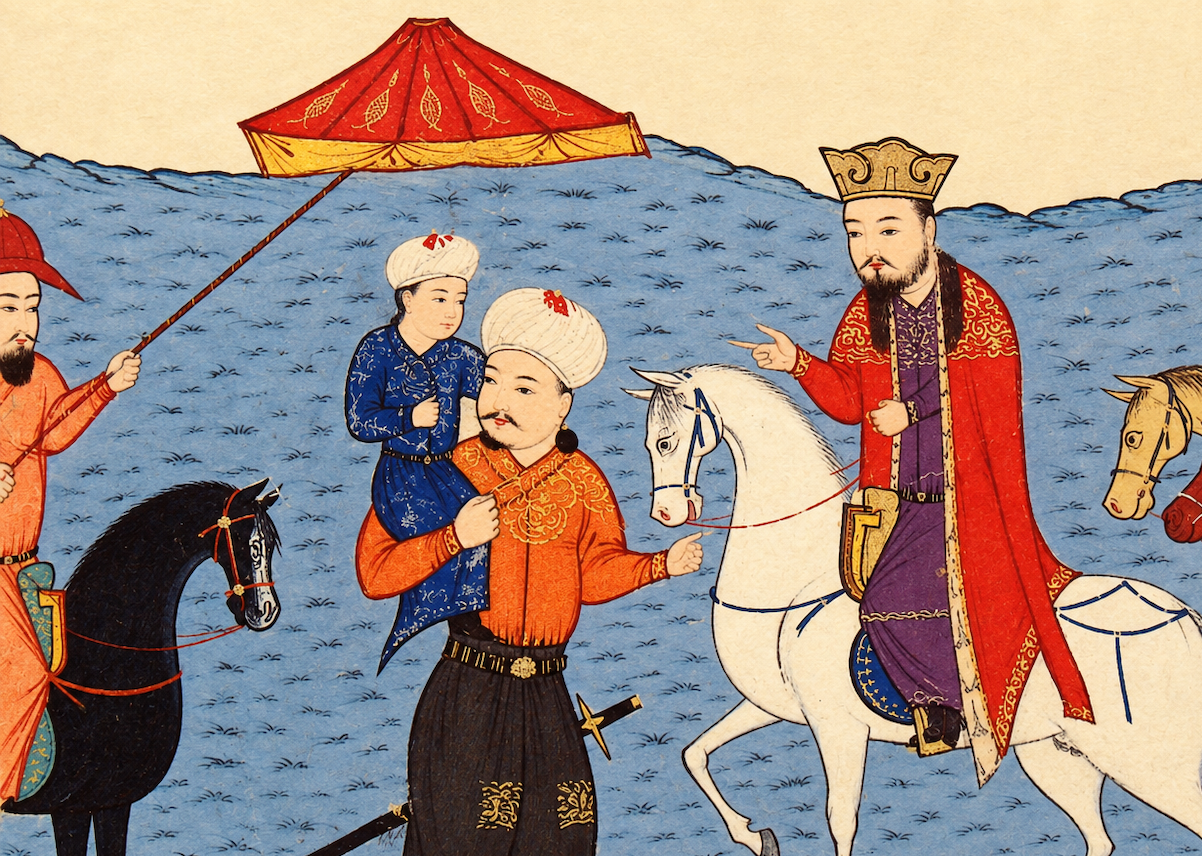
In the steppe, a child began preparing for adult life long before becoming a warrior. Boys were taught to ride, use a bow, hunt and act together with others. Behind these skills stood another principle: the younger generation grew up alongside elders whose task was to teach, lead by example and protect them until they came of age. Sources ranging from the ancient Xiongnu and Turkic peoples to the Mongol Empire and the Ulus of Jochi allow us to trace how responsibility for a young person passed from the family to a mentor and eventually to the military community.

Military divers during the search-and-rescue operation on the Caspian coast following the tragedy at naval exercises in the Mangystau Region. September 2026. Photo: Press Service of the Ministry of Defence of the Republic of Kazakhstan.
On September 24, 2026, during naval exercises in the Mangystau Region, 17 servicemen were swept into the Caspian Sea. Three managed to survive; 14 died. Criminal cases were opened under provisions concerning negligent performance of military duties resulting in serious consequences and violations of navigation rules. The investigation is ongoing and is expected to establish the precise circumstances of the tragedy and the degree of responsibility of everyone involved. Most of those who died were very young. According to published information, they included 12 conscripts, a sergeant and a senior lieutenant. The servicemen who died were born between 2005 and 2007.

This is not the first time a family in Kazakhstan has sent a son to serve and never seen him return. Shanger.kz has previously told the stories of families of soldiers who were injured or killed. Following the latest tragedy, we decided to look at how the societies of the Great Steppe treated those who were only beginning to prepare for adulthood and the life of a warrior. Who was responsible for the boy? Who taught him to use weapons? Who stayed by his side when he first mounted a horse? And what did it really mean to raise a warrior?
History does not allow us to idealise the past. The medieval steppe was a dangerous and violent world, teenagers could find themselves at war at an early age, and punishments could be harsh. Yet the sources also show that a future warrior was raised by adults over many years, and before courage and responsibility were demanded of a young man, the elders bore responsibility for him.
Upbringing Began Long Before the Army

A mounted archer drawing his bow while riding a galloping black horse. Fifteenth-century miniature attributed to the Turkish School. Topkapı Palace Museum, Istanbul. Source: Bridgeman Images.
One of the earliest descriptions of how children of the steppe were raised was left by the Chinese historian Sima Qian in his account of the Xiongnu. He wrote that small boys rode sheep and shot birds and mice with small bows. As they grew older, they began hunting hares and foxes. Adult men who were capable of drawing a war bow became mounted warriors.
More than a thousand years later, the European traveller Plano Carpini observed a similar system among the Mongols of the thirteenth century. According to his account, children began riding at a very early age, at around two or three years old, and were given bows suited to their size and gradually taught to shoot. Timothy May, a historian of Central Asian warfare, notes that this kind of everyday practice represented only the first level of training. Mongol armies were far more organised and extensively trained than the common image of “born nomad warriors” might suggest.
The First Teachers Were Mentors

Chinggis Khan advises his sons to preserve unity among themselves and avoid disputes so as not to weaken their state and power. Folio from the manuscript “Tevârîh-i Güzîde” (“Nusret-nâme”).
Among the sayings of Chinggis Khan recorded by the historian Rashid al-Din is a revealing instruction to military commanders: they were expected to teach their sons archery, horsemanship and wrestling thoroughly, and then test how well they had mastered those skills. The American historian Timothy May begins his study of steppe military training with precisely this testimony. It changes the familiar picture of how a future warrior was raised: a boy was not simply sent out into the steppe with the assumption that “he will learn”. An elder was responsible for teaching him personally and making sure he had truly mastered what was required. And that responsibility extended beyond the handling of weapons.
In the eleventh century, Yusuf Balasaguni, a native of Balasagun, wrote extensively about the responsibilities of adults towards children in the “Kutadgu Bilig”. Studies of the work show that raising a child from an early age and passing on knowledge and virtues were regarded as duties of parents and elders. In one passage, this responsibility is expressed particularly firmly: if a child grows up badly brought up, the blame falls first of all on the father who failed to fulfil his duty towards the child.
“What I Saw in You Is What I Learned”

Alan Goa and her sons. Miniature from Rashid al-Din’s “Jami al-Tawarikh”. Herat, Afghanistan. Bibliothèque nationale de France, Department of Manuscripts, Oriental Collection, Supplément persan 1113, fol. 15v.
The principle of learning through personal example is even more clearly preserved in the epic tradition of Korkyt Ata. In one story, Salur Kazan is troubled that his son Uruz has not displayed the qualities of a warrior. Uruz responds with a very simple question in essence: “When did you take me somewhere I could learn these things? What did you show me?” Kazan eventually acknowledges that his son is right and takes him along.
Hatice Fırat, who studied the upbringing of young heroes in the “Book of Dede Korkut”, notes that in these stories the father acts both as a parent and as a teacher. The main methods of learning are practice, shared activity and demonstration. The adult first shows how something is done, the young person watches, and then tries to repeat it.
When UNESCO inscribed the heritage of Korkyt Ata/Dede Korkut on the Representative List of the Intangible Cultural Heritage of Humanity, it specifically highlighted its role in transmitting moral values and positive models of behaviour, including courage, mutual respect, respect for elders and traditional knowledge. The family was the principal setting for this transmission. A future warrior needed to see someone before him whom he could follow as an example. Not only to see how that person shot a bow, but also how he behaved towards other people.
Becoming Not Only a Warrior, but a Human Being

A council of the Oghuz rulers Köl Erki Khan, Tuman Khan and Kayı Yabgu Khan with Korkyt. Miniature from Rashid al-Din’s “Jami al-Tawarikh”. Herat, 1426-1430. Topkapı Palace Museum, H.1653, fol. 387a.
Studies of the “Kutadgu Bilig” show that justice, responsibility, honesty and the importance of family are among the values most frequently emphasised in the work. Knowledge was expected to be accompanied by worthy conduct. In the epic tradition of Korkyt Ata, a young hero is expected to show more than courage. Researchers highlight respect for parents and elders, loyalty to family and companions, justice, honesty, mutual assistance and the ability not to abandon others in danger. This is the essential distinction between a person who knows how to use a weapon and a person who can be trusted with one. Military training answered the question, “What can you do?”, while upbringing was meant to answer another: “What kind of person are you?”
Adults Protected the Child First

Yesugei and his family. Miniature from a manuscript of the “Jami al-Tawarikh”. Bibliothèque nationale de France, Département des Manuscrits, Supplément persan 1113, fol. 36v.
Medieval sources contain stories in which an elder’s responsibility for the young appears not only in upbringing but also in saving a life. “The Secret History of the Mongols” tells of a battle in 1203 in which the young Ögedei, the future Great Khan, was struck by an arrow in the neck. His companion Borokhul remained beside him throughout the night, clearing clotted blood from the wound and carrying the injured young man back. The source describes the moment almost physically: when they finally reached their own people, blood still remained on Borokhul’s lips. Later, the text explicitly states that it was his actions that saved Ögedei’s life.
Borokhul himself had once been a child found after the defeat of the Jurkin camp and brought to Ö’elün, the mother of Chinggis Khan. She raised him in her own household. The story forms an almost complete circle. Adults once took Borokhul in and raised him. Years later, it was he who saved the life of a young man from the next generation.
The same chronicle also praises Altani, Borokhul’s wife, who rushed to protect the young Tolui when he was in danger. The author specifically considers who deserved the greatest credit for saving the child and gives it to Altani, because she was the first to intervene and restrain the attacker until help arrived.
The Children of Enemies Could Become Their Own

Ö’elün, mother of the future Chinggis Khan, pursuing the tribes leaving her family after the death of Yesugei. Detail from a miniature in the “Jami al-Tawarikh”, 1596.
Another phenomenon associated with steppe history is sometimes retold too simply, as though nomads deliberately “stole the children of their enemies in order to raise them as their own warriors”. The sources do indeed describe children from defeated groups being taken into the families of the victors, but it would be inaccurate to call this an organised system for abducting future soldiers. In “The Secret History of the Mongols”, Ö’elün raises several boys in her household who came into the family’s care following conflicts with the Merkits, Tayichi’uds, Tatars and Jurkins. Among them was the young Shigi Qutuqu, found after the destruction of a Tatar camp and given to Ö’elün, who accepted him as a son.
These children were not simply “turned into soldiers”. Borokhul later became one of Chinggis Khan’s notable companions and military commanders, while Shigi Qutuqu followed a different path and became a senior official and judge.
Ataliq - the Person Entrusted with a Child

A Golden Horde coin from the reign of Mengu-Timur. Bulghar mint, AH 672-673 (1273-1275).
The Ulus of Jochi had an institution known as the ataliq, from the Turkic word “ata”, meaning father. The term referred to a tutor, guardian and mentor responsible for children of the ruling dynasty. Iskander Izmailov, a scholar of the history of the Ulus of Jochi, writes that an ataliq could in practice take the place of a boy’s father during his upbringing. When the pupil grew up and became khan, the ataliq often remained at his side, becoming one of his closest advisers, holding high state office, assisting in government and sometimes taking part in military command. The Tatar Encyclopedia likewise defines an ataliq as a tutor to khans’ children in the Golden Horde and the later Tatar khanates, someone who accompanied a minor ruler and could eventually become his principal adviser.
Not One Adult, but an Entire Circle

Ghazan being breastfed. Miniature from Rashid al-Din’s “Jami al-Tawarikh”, early fourteenth century.
Izmailov describes the institution of emildesh, or milk brothers, under which a child from the Chinggisid dynasty could have a wet nurse from another clan from infancy and grow up alongside her children, forming a relationship that later developed into a network of personal loyalty and mutual obligations between adults and entire clans. A child therefore did not grow up alone: around him were his parents, tutor, milk relatives, the older men and women of the family, and the peers with whom he was raised.
Hunting Was Far More than Entertainment

Oghuz hunting. Miniature from Rashid al-Din’s “Jami al-Tawarikh”, fourteenth-fifteenth centuries. Topkapı Palace Museum, manuscript H.1654.
Hunting taught horsemanship, the use of weapons, the reading of terrain, endurance and coordination with other riders. Large collective battues were especially important. Timothy May shows that among the peoples of Inner Asia such hunts were used as practical preparation for military manoeuvres. One ruler of the Khitan Liao Empire explicitly stated that hunting served as an exercise in warfare, while among the Mongols the mass battue known as the “nerge” trained large groups of riders to move in coordination, encircle territory, maintain order and follow commands. For a young person, hunting was also a school of adulthood: he remained alongside experienced people, watched, asked questions, repeated what he saw and made mistakes while there was still someone nearby capable of correcting him. In the “Book of Dede Korkut”, hunting is precisely the setting into which a father takes his son so that he can begin gaining experience, a form of apprenticeship before a real encounter with the enemy.

Abaqa Khan on horseback; his son Arghun holds the young Ghazan. Miniature from Rashid al-Din’s “Jami al-Tawarikh”, fourteenth century. Wikimedia Commons / Public Domain.
The medieval epic also reminds us that training could be dangerous. Uruz’s story ends with what seems to be a harmless exercise turning into captivity for the young man, after which his father, mother and other Oghuz set out to rescue him.
A Warrior Learned to Be Responsible for Others

A clash of Mongol mounted archers. Illustration from Rashid al-Din’s “Jami al-Tawarikh”, probably Tabriz, first quarter of the fourteenth century. Berlin State Library, Oriental Department, Diez A fol. 70, p. 60.
Over time, the roles changed. The boy who had once been held steady on his first horse became a confident rider; the one who had been taught to shoot came to master the war bow; the child protected by adults gradually became someone expected to protect others. This transition can also be seen in the military organisation of the Mongol period, when individual skills were reinforced by collective training, hunting, strict discipline and a clear command structure. Timothy May emphasises that the strength of Mongol armies lay not simply in having large numbers of skilled riders, but in their ability to act in coordination, carry out complex manoeuvres, maintain discipline over vast distances and subordinate themselves to a common objective.
“What You See in the Nest, You Carry with You When You Fly”

Mongols preparing food. Miniature from Rashid al-Din’s “Jami al-Tawarikh”, circa 1430. Bibliothèque nationale de France, Paris.
Later Kazakh tradition preserved this principle in proverbs: “Тәрбие - тал бесіктен” - upbringing begins from the cradle; “Ұяда не көрсең, ұшқанда соны ілерсің” - what you see in the nest, you carry with you when you fly; “Әке көрген оқ жонар, шеше көрген тон пішер” - one who watches his father learns to make an arrow, and one who watches her mother learns to cut and sew clothing. The final proverb conveys the principle of learning through personal example particularly well: the father does not simply order his son to make an arrow. The son first watches how his father does it, then receives the tools, learns under his supervision, accepts corrections and only with time begins to do everything himself.
When They Could Not Be Saved

“Rustam Blames Kai Kavus for the Death of Siyavush”. Miniature from the “Shahnama” of Shah Tahmasp, circa 1525-1530. The Metropolitan Museum of Art, New York.
The Franciscan William of Rubruck, who travelled through the Mongol Empire in 1253-1255 and visited the court of Batu, left one of the rare direct accounts concerning the death of a child. He wrote that the dead were mourned with loud lamentation. A child’s death also had a distinct ritual status: a person who had been present when the child died was not permitted to enter the dwelling of the Great Khan for a month.
One of the best-known stories in steppe tradition is directly connected with the family of Chinggis Khan and Jochi. A medieval version of the account of Jochi’s death survives in the Turkic chronicle “Shajarat al-Atrak”, compiled, according to researchers, after the middle of the fifteenth century. It tells how, when news of Jochi’s death reached the camp, those around Chinggis Khan did not dare tell his father directly. The difficult task was entrusted to Ulugh-Jirchi, a man of standing at court. He began indirectly, speaking of a clouded sea and a fallen white poplar that no one could raise. Chinggis Khan replied that his son Jochi would be able to put things right. When Jirchi repeated his words and tears appeared in his eyes, the khan understood their meaning himself and asked whether Jochi had died.
Chinggis Khan mourns his son, after which the emirs and noyons rise, perform the custom of condolence and begin lamenting with him. The story of Jochi’s death was already present in the medieval Turkic written tradition and later developed into numerous Kazakh versions, including the famous legend of “Aqsaq Qulan”.
Estirtu - Before Saying the Worst

A besik used by nomadic Kazakhs. Photograph by Paul Labbé; Molteni reproduction for a lecture by Paul Labbé. Bibliothèque nationale de France / Gallica.
In traditional Kazakh culture, the announcement of a death developed into a distinct custom known as estirtu. Such news was not entrusted to just anyone, but to a person who had authority and knew how to speak. Respected members of the community were expected to inform the family of a death. There were even rules governing the behaviour of the person bringing the news: one was not supposed to gallop into the aul or rush into the house.
The message itself was often delivered gradually. People first spoke about the transience of human life, used images from nature and recalled others who had also passed away. Then, through hints and indirect language, the listener was gradually led towards an understanding of what had happened, and only after that was the name of the deceased spoken. The point was not to conceal the truth, but to prepare a person for a truth they would have to endure.
Researchers of traditional Kazakh family folklore identify an entire system of mourning genres. Estirtu was followed by көңіл айту, the offering of condolences and support to the bereaved, and then by жоқтау, the lament for the deceased. In жоқтау, people recalled the person, their origins, their deeds and the good they had accomplished during their lifetime. The tradition of lament is considerably older than later Kazakh society. Researchers find elements of memorial poetry in ancient Turkic written monuments, and this tradition later continued in the work of the zhyrau and in family ritual folklore.
Sources:
1. Sima Qian. “Shiji”, “Records of the Grand Historian”, chapter on the Xiongnu.
2. Timothy May. “The Training of an Inner Asian Nomad Army in the Pre-Modern Period”.
3. “The Secret History of the Mongols”. Accounts of Ö’elün, Borokhul, Ögedei, Tolui and children incorporated into the families of the victors.
4. I. L. Izmailov. Studies of the social structure of the Ulus of Jochi.
5. “Qazaqstan Tarihy” and materials on the traditions of estirtu / joqtau.
Editor’s note: the archival illustrations and photographs used in this article were edited using artificial intelligence technologies.

Shangerei Bokey shaped early Kazakh visual culture as the first photographer and educator. Story by Karlygash Nurzhan for Shanger.kz

The scent history of the Great Steppe: from Old Turkic yıpar and musk to ätir, jūpar and contemporary perfumery in Kazakhstan.

The history of the kurultai, from steppe councils to Kazakhstan’s modern parliament, explained by historian Zhaksylyk Sabitov.

The history of football, from ancient ball games to Kazakhstan’s clubs, Kairat and the national team. A Shanger.kz feature.

The new mosque opening in 2025 will welcome over 20,000 worshippers and strengthen Almaty’s expanding religious infrastructure.

The history of journalism in Kazakhstan, from saýyn aitý and zhyrau to newspapers, radio, television, and digital media.

The role of Islam in Kazakhstan: education, unity, identity, moral values, and compassion toward animals.
Comments
No comments yet. Be the first to comment!