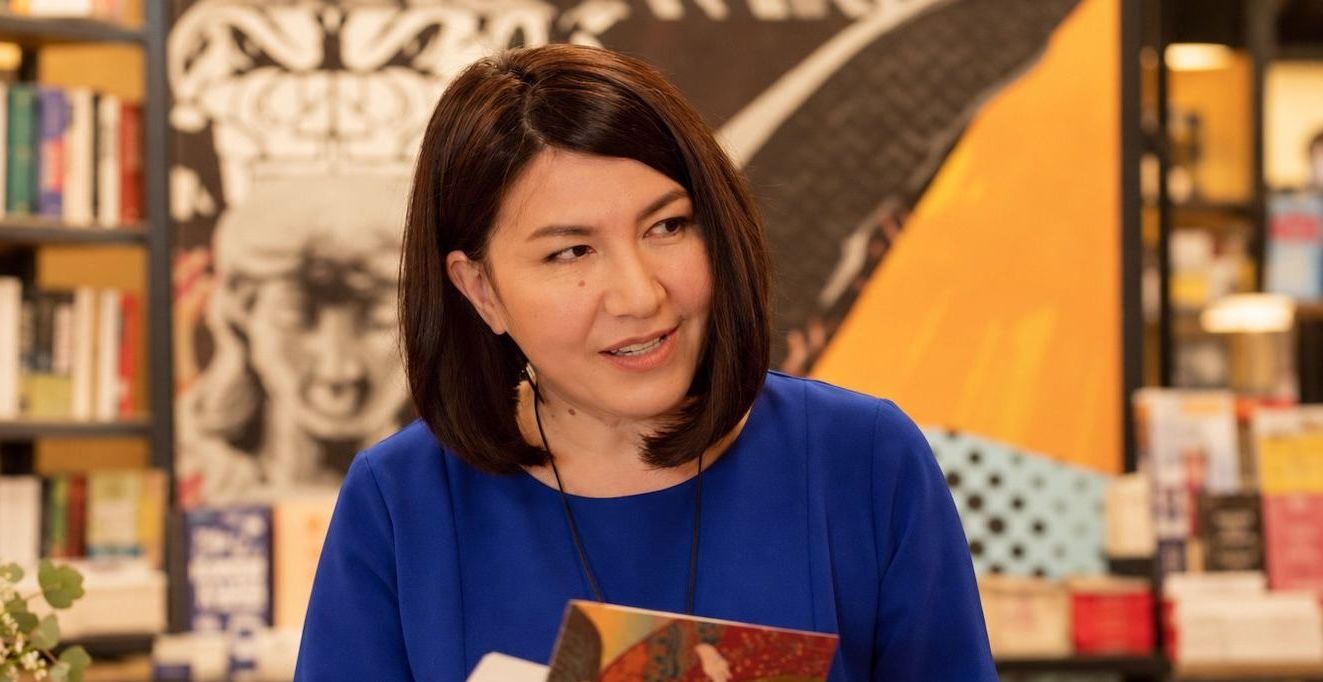
"Sometimes a Small Phrase or Detail Grows into a Major Theme." Maria Omar on Creativity and History
The writer was born in the Orenburg Region into a Belarusian-Kazakh family and moved to Kazakhstan in 2000. Her books, Honey and a Little Wormwood and Rumiya, explore family memory, Kazakh traditions, and women who must choose between the expectations of those around them and their own freedom. What began as a desire to preserve memories of her grandmother, Akbalzhan Azhe, turned into a literary success: the combined readership of the Russian-language versions of her two books has approached 50,000. We spoke with the author about how personal experience becomes literature, why readers interpret the same episodes differently, and whether it is possible to earn a living as a writer in Kazakhstan today.

What should readers know about you as a person to better understand your books?
"I was born in a small settlement in the Orenburg Region, near the border with Kazakhstan. My father is Belarusian and my mother is Kazakh. My grandmother, Akbalzhan Azhe, played a major role in raising me. She became the main character of my first book, Honey and a Little Wormwood. In 2000, I moved to Kazakhstan on my own.
"I write in Russian about Kazakh women, everyday life, traditions, and contemporary issues. My characters also often find themselves at the intersection of cultures, languages, family customs, traditional values, and personal freedom. They have to make difficult choices, and those choices are usually different from what others expect of them.
"I worked as a journalist for a long time, so I developed a habit of cutting out anything unnecessary. This is particularly noticeable in my first book, where the prose is pared down to the bare minimum.
"Although my first book contains elements of autofiction, while Rumiya is a half-fictional story, I revealed more of myself as a person in my second book. The novel's main character is a rather reserved young woman. She has a great deal of emotion inside her, but rarely expresses it outwardly. I've noticed that people who like her seem very understanding to me, and I feel a strong connection with them. Those who express their emotions easily and vividly usually prefer other characters or entirely different books."

How did your creative journey develop? When did you realize literature could become more than just a hobby?
"I used to think I wasn't capable of inventing plots for fiction, although I had always tried to write. As a child, I received a rejection from the Soviet magazine Koster, where I had submitted my poems. It was a fair decision because they were far too ordinary. So I switched to prose. Seriously, though, when I was at school, I sometimes played at being a writer. For example, I would observe myself or other people from the outside and compose sentences such as, 'She stood up and looked at him.' It's funny to remember that now, but at the same time, I realize my interest in writing was already there.
"I made my first attempts at writing fiction during my first maternity leave, when I was twenty-five. They were stories about my university years and life in a student dormitory. I was going to reread them when I started writing Rumiya, since that theme appears in the novel too, but I couldn't bring myself to do it. To me now, it would be almost like secretly reading someone else's diary.
"I began writing my first work of fiction in 2020, after my father passed away. I had been planning that book for a long time, but I kept putting it off, thinking there was still time. When my father died, I realized there wasn't. Something can happen to us at any moment, so it's better to do what matters most right now. Above all, I wanted to preserve our family history for my children. Later, I wanted to share the writing with others as well. I wrote and immediately posted excerpts on Facebook. People began actively commenting on those posts, sharing them, writing about their own memories, and asking me to write more. That's when I realized the book might interest people beyond my family and friends. I started working on the style to turn those notes into literary prose, and in some ways my journalistic experience actually got in the way. It was difficult to change my approach in certain passages.
"I didn't expect the book to do so well. It was the readers' interest and thousands of positive reviews that motivated me to continue writing, and I began thinking about a second book."

If we consider your family's story as part of Kazakhstan's history, which historical events had the greatest impact on your relatives' lives? Are there family stories you have included in your books or would like to tell someday?
"I think I've already told almost everything from my family history in my books. Of course, some events were left out because I was concerned that certain relatives might feel uncomfortable or offended by them.
"As for historical events, they all affected our family in one way or another. To some extent, they even shaped it. My grandmother Akbalzhan lost both her father and mother during the famine, and perhaps if the revolution and the confiscation of property from wealthy peasants had never happened, her life would have turned out differently. On the other hand, when you look at tragic events almost a century later, you can also see positive consequences. For example, if her first husband hadn't lost a cow in a card game, she wouldn't have left him. If her second husband hadn't died in the war, she wouldn't have married my grandfather. Then my mother wouldn't have been born, and neither would I. If my paternal grandfather hadn't been wounded in battle and ended up in a hospital, he wouldn't have met my grandmother Maria, and my father would never have been born. It's fascinating to reflect on all this. These realizations came only after I had finished writing the book and was able to look at my family history from the outside."

How has your relationship with readers changed? Have readers ever interpreted your books in ways you hadn't expected, or shared stories that made you see your own work differently?
"When I was first invited to discuss my book at a book club, to be honest, I wasn't happy at all. I was frightened. I had been warned that books were usually torn to pieces at these meetings, and I almost declined, trying to convince myself, 'The book has already been written, so why do I need criticism? I can't change it anyway.' But I went to the meeting after all. Everything turned out much better than I had expected. Most of the women thanked me, said kind things, and some even cried. After that, it became easier for me to accept invitations to similar events. During discussions of my books, people often begin sharing personal stories. When we talk about the family saga Honey and a Little Wormwood, they invariably share memories of their grandmothers, fathers, and childhoods in aul villages. When we discuss Rumiya, they remember the 1990s, their student years, and first love. What's interesting is that everyone finds something of their own. For example, recently one reader drew attention to a tiny episode in which Abika, Rumiya's grandmother, forbids her from fighting with boys. This sparked a heated discussion. Some believed it was right, arguing that a girl should behave properly. Others said that being raised this way might lead a woman to endure abuse for years later in life, unable to stand up to a male abuser, and not necessarily in a physical sense. That's how a small phrase or detail can sometimes grow into a major theme. And it's no accident: I deliberately put these things into the text. When a reader notices not only the major events but also discovers these little hidden treasures, I quietly rejoice."

What are your current book sales figures? How many copies have been sold, which of your works are most in demand, and how have sales changed in recent years?
"Honey and a Little Wormwood remains my undisputed bestseller. Its fifth print run is now being prepared. It has been selling at almost the same rate for four consecutive years. If we combine the readership of the Russian-language versions of Honey and a Little Wormwood and Rumiya across print, digital, and audiobook formats, the figure comes to around 50,000. Both of my books were among the ten most-read books by Kazakhstanis on the Yandex Books service in 2025. The first print run of Akbalzhan in Kazakh has also sold out. The book was released at the end of March this year. I'm also pleased that the Spanish-language edition of Honey and a Little Wormwood recently ranked first in sales among my publisher's books at an exhibition in Madrid."

Is it possible to build a sustainable writing career in Kazakhstan today through book sales? To what extent do authors have to handle their own promotion, and what are the main challenges Kazakhstani writers face in the book market?
"You can build a career, but making a living from fees and royalties is still very difficult, especially if you write literary fiction. I've heard about people making substantial amounts of money from genre fiction, but I don't know the exact figures. Speaking for myself, my income from books is lower than the average salary. For the first time, I received a substantial payment this spring, but if you divide it by the number of months I worked, the picture isn't nearly as encouraging.
"Of course, I would love to focus entirely on writing books without having to worry about earning an income. To make that possible, you either need access to major markets or strong government support, as exists in some countries. Another option would be to quickly write ten books to generate a good combined income. But I write one book approximately every two years, focusing on the quality of the text.
"As for promotion, publishers help as much as they can. They organize participation in exhibitions and publish promotional materials, but most of the promotional work still falls on the author. Or it happens spontaneously, through the initiative of other people, as in my case. I post irregularly on social media and attend events when I'm invited, but I almost never organize them myself because it takes too much energy. Even so, many of my colleagues consider me active in this respect because I keep appearing here and there and often repost reviews and videos from meetings.
"The main challenge for emerging authors is that there are still very few places in Kazakhstan where they can get published. For a while, in 2024 and 2025, we witnessed a boom. During that period, Zerde and Meloman Publishing released many interesting new titles by debut authors, which really energized the market. But now there seems to be another slowdown. Most books are being self-published, and their quality varies enormously, from excellent works to frankly weak ones."

An interview with Magira Kozhakhmetova — a legend of Kazakhstani journalism — about the profession, the era, and the people she spoke with.

Ekaterina Smolyakova’s journey from childhood to KBTU, her love for Kazakh language, teaching, and inspiring a new generation of students.

Shangerei Bokey shaped early Kazakh visual culture as the first photographer and educator. Story by Karlygash Nurzhan for Shanger.kz

Zhanat Karatai’s Story: From the Mother of a Child with Autism to an Expert, Adaptation Method Author, and Inclusion Advocate
-2-600x305.jpg?2026-08-28T07:19:38.581Z)
Book club founders from Aktau, Almaty and Astana who are building reading communities and bringing people together through books.

How Astana’s artists and sculptors live and what could strengthen Kazakhstan’s art scene. Photo report by Karlygash Nurzhan for Shanger.kz.
Comments
No comments yet. Be the first to comment!