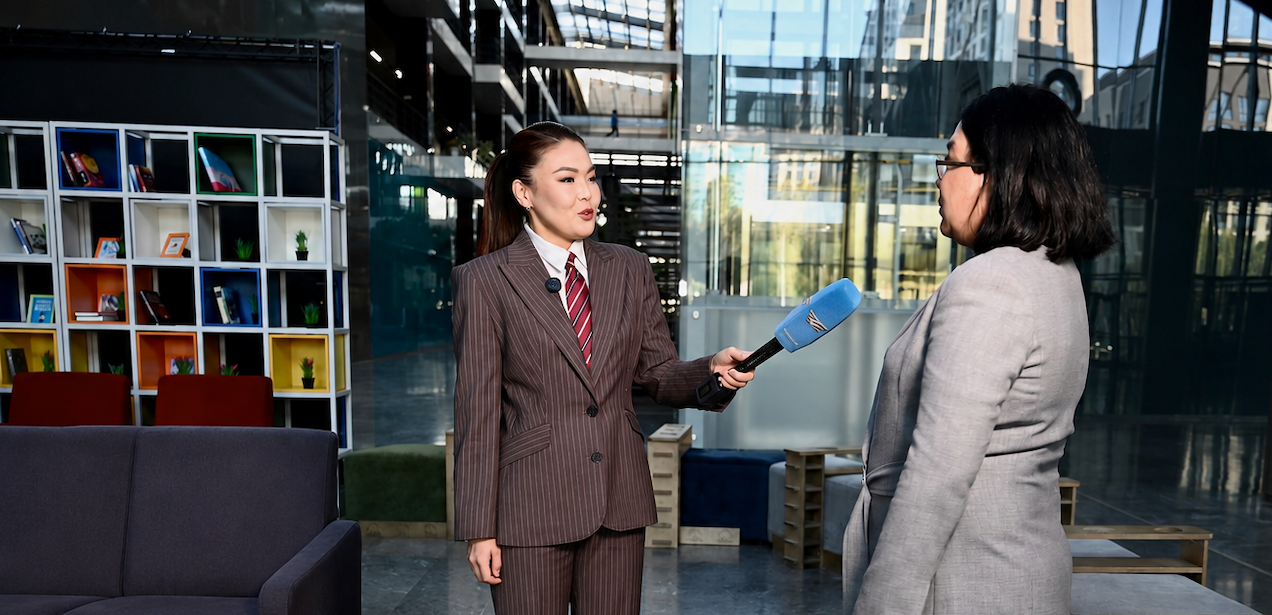
A joint project by Shanger.kz and Aleminform is dedicated to the people working in Kazakhstan’s media industry. We spoke with presenters, journalists and producers about how they entered the profession, what happens behind the scenes and the situations they have to deal with in their work.
“At the beginning of my career, people would needle me: ‘But you’re not a journalist’”

Madina Almoldina, news editor and anchor at Channel 7.
“I got into television largely by chance,” Madina says. “I came to an audition where there were a lot of applicants and the competition was intense. I understood that my chances were slim. At one point, a senior official who had previously been connected with journalism happened to walk past the studio together with the channel’s management. I had not even had a chance to say anything yet when he noticed me and said, ‘What an interesting type. You haven’t had anyone like her before.’ After that, they kept me in the audition process. So, to some extent, I simply got lucky.
“But they did not put me on air straight away. My boss said, ‘Until you shoot three reports, you’re not going on air. We don’t need talking heads.’ My first story was about the demarcation of the Kazakhstan-Uzbekistan border. There were no social networks back then, the internet was only beginning to develop, and it was difficult to find anything close to the amount of information available today. I went from newsstand to newsstand, bought newspapers and read everything I could find on the subject. I first went on air on November 1.”

“I am not actually a journalist by education. I am an economist and a manager. Early in my career, people would sometimes needle me about it: ‘But you’re not a journalist.’ So I took unpaid leave and went to Moscow for a month to study at Ostankino, taking professional development courses for radio and television staff. Among other things, they taught us how to prepare ourselves for broadcasts and do our own makeup. Since then, stylists have done my hair, but I prefer to do my own makeup. After all, nobody knows your face better than you do.”

“When I started working, competition in television was much tougher than it is now. Sometimes someone would erase the teleprompter, rearrange words in the script or deliberately try to throw you off balance just before a broadcast. That is why, even now, I always make sure I have a printed copy of the script in front of me. If something happens to the teleprompter, I simply switch to paper. Over the years of live broadcasting, all sorts of things have happened: flies have landed on my face, lights have exploded, there have been technical failures. With time, you simply learn not to react and to keep going.”
“One of the projects of recent years that I am especially proud of was the political debates on Channel 7. After the broadcast, I heard many people say it was the first political show in 30 years that they watched from beginning to end without wanting to switch channels. When a team creates something the market has never seen before, it gives you enormous satisfaction. The only fear after something like that is whether you will be able to make the next project even better.”
“Can I come with you? I’m curious, and I skip classes anyway”

Almas Ashim, news anchor at Channel 7.
“I didn’t choose television. I think television chooses the person,” Almas says. “It all happened by accident. I saw some beautiful girls in our information technology building. It turned out they were journalism students and were going to an audition at a radio station. I asked, ‘Can I come with you? I’m curious, and I skip classes anyway.’ That is how I ended up in media. My first serious school was the youth station Radio Astana. Its head, Gulmira Karakozova, told me, ‘Saltanat will show you the ropes. You have until Saturday. If you learn how to put together a rundown and don’t fall apart during the live broadcast on Saturday, welcome to the team.’ Then the big day came: the rundown was ready, the microphone was on, the red light came on - and the nerves were overwhelming.
“The nerves never disappear completely, even with experience. If it is a new studio, if you are seeing a fresh script for the first time, or if you know the broadcast is exclusive and everyone is watching you, you still get nervous. Recently, we were the first media outlet to announce the results of the vote on the Kurultai. When you understand that you are the one holding the exclusive information at that moment, it feels completely different.
“My voice started taking shape when I was still a teenager studying at the cadet corps. Then came my great love for Muslim Magomayev’s music, some vocal experiments, and later radio and television. I think all of that together shaped the way I sound on air today.”
“I’m a field journalist, so I don’t spend that much time in the makeup room”

Botagoz Aitzhanova, journalist and analytical editor of the “7 Kün” programme on Khabar.
“Because I work at a television channel, we have our own unwritten rules about appearance,” Botagoz says. “Large accessories, revealing necklines and overly bright manicures are discouraged. Bright colours in clothing, however, are perfectly acceptable - red and purple look good on air. But I’m a field journalist, so I don’t spend that much time in the makeup room. We usually don’t have time to sit for long hair appointments. We shoot outdoors, travel outside the city, go on assignments and work in all kinds of conditions.
“This winter we went to Buiratau State National Nature Park to shoot a story about bison. We left at seven in the morning, it was freezing, and we spent several hours travelling along winter roads. What kind of full makeup can you even talk about in those conditions? A hat, warm clothes, thick tights, heavy trousers, a jacket - and off you go. To record the piece looking at least reasonably presentable, I took a basic makeup bag with me and got myself ready in the car on the way to the bison. This week I was filming a story about the LRT - how the work is progressing and how construction is going. You stand there recording a stand-up, and the wind blows your hair into your eyes, your nose and your ears.

“I don’t want to brag, but I suppose every journalist has several suits hanging in their wardrobe. In June this year, I received a Presidential grant and decided that I needed a formal, understated look for the award ceremony. I chose a brown suit by a Kazakh designer.
“Before television, I spent almost ten years working on newswires, including at Tengrinews. There is always competition on a news desk: who will publish first, who will find the exclusive. You need to know the agenda in advance, understand who the speakers will be and what you need to ask them. The principle does not really change in television, but here everything depends much more on the team - the camera operator, director, lighting and editing. When I first moved into television, I couldn’t understand why so many people had to be involved in a single story. Later I realised that this is exactly how the final product comes together.”

“Over the years, there have been many cases where something genuinely changed in people’s lives after our reports. Students began receiving their scholarships, someone was helped to return from abroad, money was raised for someone’s expensive surgery, residents managed to get their courtyards improved. That kind of feedback is very motivating. Of course, journalists burn out. Sometimes you think, ‘That’s it, I can’t do this anymore.’ Then you rest, or someone writes to tell you that your story helped them, and you go back to work. I think many journalists, myself included, keep going because of that kind of motivation.
“I still remember one professional blunder. In 2018, I was on assignment in China: first in Beijing covering the head of state’s visit, then in Qingdao for the SCO summit. At the airport, pleased with how the assignment had gone and how I had worked, I wrote to my colleagues in Kazakhstan: ‘Can you imagine? The head of state said our website is number one, the coolest website.’ It was a joke. But I hadn’t taken into account the peculiarities of internet access in China and how the VPN was working. My next message - ‘Guys, it was a joke’ - never went through. Meanwhile, the newsroom had already started looking for the video, calling press offices and trying to find out when and where the statement had been made. My first message had already made its way to senior management. I was terribly embarrassed to return to the office, embarrassed about the joke. I went to my boss and explained everything. They listened calmly, smiled and said, ‘Don’t do that again.’”
“I don’t like journalists writing their texts with ChatGPT”

Alexander Aksyutits, producer and director of the TOP PRO CINEMA production centre.
“I’m a media manager and producer, and I used to be a journalist as well,” Alexander says. “Today I work on television series, media projects and television programmes.
“There was a time when we worked only for television, print and radio. Now social media and the internet dominate. It has accelerated our work tenfold. A report or investigation that once could take a week now has to be produced in a matter of hours and distributed immediately. But I absolutely do not like journalists writing their texts with ChatGPT. I don’t like the fact that people have stopped double-checking information, publish things carelessly and don’t think about the consequences. I don’t like the fact that journalism is losing its human face and forgetting its central principle - telling people about people.”
“The first thing I would advise young people,” Alexander says with a laugh, “is to listen a little less to old-timers like me. When I entered this field as a young man, I also listened less to the older generation and focused more on what I believed was driving the market forward. You should listen to experienced people so that you can avoid major mistakes. But first and foremost, your profession should be shaped by you - by your own view of the world and your own vision of the future. If you listen to everyone too much and rely on stereotypes, you will never create anything new or interesting.”
“We went to Black Berkut, where Vladislav Chelakh is being held”

Saltanat Arykbaeva, journalist and presenter at Jibek Joly radio.
“We make the programme ‘Truth in Detail’ together with Askar Dzhaldinov, a well-known Kazakh journalist who specialises in crime journalism and has written several books about high-profile crimes,” Saltanat says. “Together with the editorial team, producers and the programme’s author, we discuss the topics we want to investigate, select the most high-profile cases and then begin gathering documents. If my topic is an organised crime group, I write to the Prosecutor General’s Office and ask them to provide speakers, the court ruling and other materials. There are closed cases where the verdict is not publicly available. In those situations, we submit an official request. We work with the Prosecutor General’s Office, the Ministry of Internal Affairs, regional authorities and specialised government agencies.
“We went to Black Berkut, where Vladislav Chelakh is being held. And I think the Chelakh case is one of the topics our audience asks about most often, and one that interests me personally as well. There are still many unanswered questions surrounding the case. People want to understand whether he really committed the crime or whether there was some external factor that influenced the court’s decision. Unfortunately, we have not yet reached an understanding with law enforcement that would allow us to investigate the subject fully.”

“We also did a great deal of work on the Perizat Kairat case. It was one of the most widely discussed stories, and we produced several films about it. I spoke extensively with prosecutors. We genuinely looked for third parties because we wanted to conduct an honest investigation. But according to the case materials, there was no trace of bank transfers to third parties, and it was established where and how the money had been spent. After programmes like these, people often write to me: ‘You’re wrong,’ ‘You investigated this incorrectly,’ ‘Everything you said is untrue.’ But we rely on the verdict and the court ruling. I cannot collect rumours and walk through corridors asking, ‘What have you heard about this person?’

“This kind of work can lead to threats. The most memorable case came after a story about an organised crime group of accountants in Taldykorgan. The mother of one of the convicted people called me and said, ‘I’ll find you. I’ll make your life very interesting. Who do you think you are?’ It was unpleasant. There were other things too: calls in the middle of the night, phone harassment, someone repeatedly writing and calling. At times I had the feeling that someone was watching my car - I would find punctures and other problems. At one point, law enforcement helped me, and those issues were resolved.
“We are dealing with crime, after all, and with people who are capable of a great deal and who already operate outside the law. So yes, it really can be dangerous. But we do not abandon a subject simply because it is difficult. There have been cases where, for safety reasons, I did not appear on camera at all and my voice was not used either. I remained only the author and journalist behind the report.”
“The January 2022 events were the hardest experience for me”

Askar Mendybayev, television presenter, correspondent, author and host of the “Global Events” programme on Khabar.
“I taught law at universities in Karaganda for almost eight years, even though I had always dreamed of working in television,” Askar says. “Then I gave my students their final exam and decided to change careers completely. I started as a trainee in Karaganda, then worked at KTK, and later joined Channel 31.
“There were times when I had to go on air in extremely difficult circumstances. For example, there could be an earthquake in Almaty while you were live on air. The teleprompter often failed, so you would read from paper and improvise. After 15 years on air, that is not the biggest problem. There were also broadcasts when, an hour or two before going on air, I was told that a relative or someone close to me had died. It is difficult, but you still have to go on air. The emotions come later.
“The January 2022 events were the hardest experience for me. We went live several times a day at our own risk. We were told, ‘If you don’t want to do it, you can refuse. Nobody will force you.’ But we didn’t refuse. I went to the square with Irina Sovetzhanqyzy. We barely made it back, but we brought the footage with us. The next day, we were told to evacuate because a crowd of unknown people had approached the television station. It was frightening. Elsewhere, television stations were being attacked, people were dying, our colleagues were dying. You walk into the studio and understand that you may not walk back out.

“There was almost no information. We did not just read from the script; we said what we ourselves knew and tried to reassure the people of Almaty and Kazakhstan as a whole. I remember Aida Boranbay and me clipping on our microphones as we were walking and going on air in turtlenecks and jeans. At that point, television rules and appearance no longer mattered. The main thing was not to frighten the viewer. Communications were barely working, social networks were inaccessible, and television remained one of the few sources of information. People turned on their televisions looking for the latest news and for hope that everything in the country would be all right.
“Three or four minutes before going on air, I would run different scenarios through my head: if something happened, how would I save Aida, where could I hide her, could I lock her in the makeup room, would we have to jump from the second floor? She is a mother of two, and that is what goes through your mind. But then the camera comes on and you go live anyway. In those days, the entire newsroom worked: anchors, correspondents, camera operators, video engineers, directors, graphics staff and drivers. We wrote together, put the rundown together, went out on assignments and went live. Nobody forced anyone, but people still came in and worked. That is the job we do…”

An interview with Magira Kozhakhmetova — a legend of Kazakhstani journalism — about the profession, the era, and the people she spoke with.

The history of journalism in Kazakhstan, from saýyn aitý and zhyrau to newspapers, radio, television, and digital media.

The project helps school students consciously choose a future profession based on their abilities, interests, and real-life skills.
Comments
No comments yet. Be the first to comment!