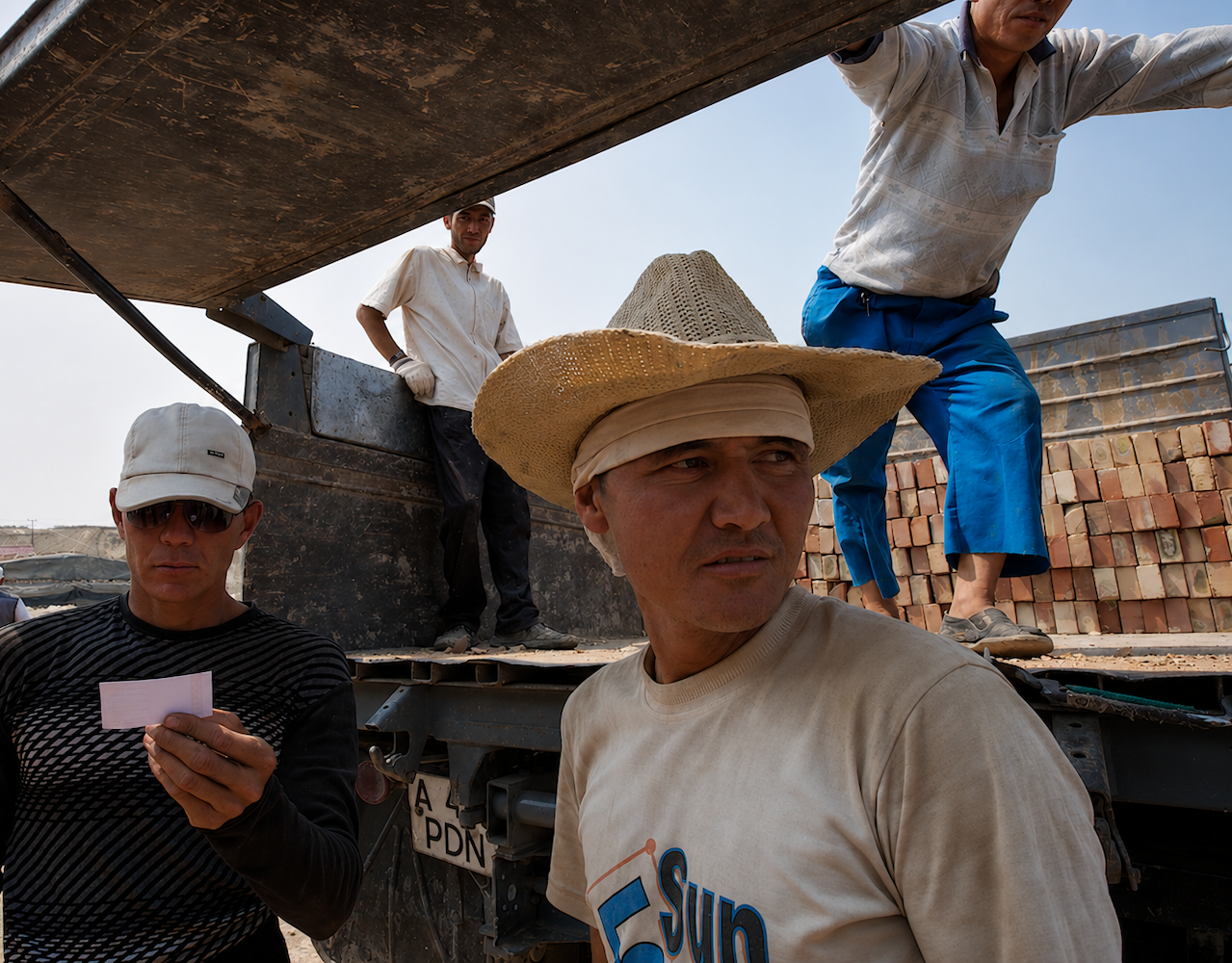
Ahead of Builders’ Day, we decided to dedicate this photo essay to one of the oldest and most familiar building materials - brick.
Brick seems like one of the simplest building materials imaginable. Clay, water, fire - the same technology humanity has been using for thousands of years. Yet behind an ordinary rectangular block lies the history of craftsmanship, architecture, industry, and entire cities. In what is now Kazakhstan, that history began long before the emergence of modern factories and stretches from the medieval kilns of Otrar to the automated production lines of the twenty-first century.

During excavations at Otrar, archaeologists discovered a brickmaking workshop dating to the thirteenth and fourteenth centuries - a complex where a medieval craftsman once worked. At its center stood a purpose-built two-level firing kiln. Fuel burned below, while heat rose through a system of arches and channels into the chamber where the bricks were placed. The structure incorporated air vents and ventilation channels, and bricks were loaded and removed after firing through openings in the sides. Nearby were rooms where the bricks were probably stored before being placed in the kiln.

Despite the centuries that have passed, the basic principles of production have changed very little. First, suitable clay has to be found, cleaned and prepared, mixed with water, shaped into bricks, dried to remove moisture, and only then exposed to fire. A mistake at any stage could ruin the result. A brick that had not been dried sufficiently would crack when heated, while improper firing could make it too brittle or, conversely, cause it to deform.

In the tenth to twelfth centuries, medieval brick was more than just a building material. Craftsmen of the Karakhanid era learned to turn it into an element of architectural decoration, creating intricate geometric patterns and ornaments through brickwork. This can be seen particularly clearly in the surviving monuments of Karakhanid architecture.

While studying the eleventh-century Karakhan Mausoleum in Taraz, archaeologists discovered more than thirty varieties of shaped brick. Each element required its own mold, a precise clay composition, and skilled firing. A wall ceased to be merely a wall - the surface of the building became an intricate geometric design.

The craftsmen who created the eleventh- to twelfth-century Aisha Bibi Mausoleum went even further. Its facades are covered with dozens of types of ornamented terracotta. Each tile went through the same journey from raw earth to fire, but now the craftsman had to do more than produce a durable building material: he also had to reproduce an intricate pattern.

As far back as a thousand years ago, the production of architectural ceramics in what is now Kazakhstan already required a division of labor. Some people extracted the clay, others prepared the mixture, others shaped the pieces, while still others supervised the drying process. Firing remained the most critical stage. The person tending the kiln had to understand fire almost intuitively: when to increase the heat, when to reduce it, and how long the pieces needed to remain inside.

Traces of similar production sites have been found in different parts of Kazakhstan. At the Zhaiyk settlement near present-day Uralsk, archaeologists discovered a brick-firing kiln dating to the thirteenth to fifteenth centuries. It was used to produce not only ordinary building bricks, but also terracotta facing elements, glazed tiles, and large ceramic vessels.

This was no longer a matter of making a few dozen bricks at home. A medieval city required a constant supply of building materials. Thousands of pieces were needed to construct houses, bathhouses, public buildings, mausoleums, and other structures. A production system gradually developed around construction itself: raw materials, fuel, workshops, kilns, workers, and the transportation of finished bricks.

Several centuries later, brick found itself at the heart of the development of very different cities. States, cities, and architectural traditions changed over the following centuries, but brick remained one of the principal building materials in southern Kazakhstan and in cities along the trade routes. Both sun-dried and fired bricks continued to be used. They were used to build homes, mosques, madrasas, mausoleums, and utility structures. In the eighteenth and nineteenth centuries, new fortifications, trading settlements, and towns began to grow across Kazakhstan.

In the second half of the nineteenth century, Verny - the future Almaty - was being developed rapidly. Timber remained an important building material, but its use was gradually restricted, in part to preserve the surrounding forests. Buildings made of sun-dried brick, rammed-earth houses, and structures built from fired brick became increasingly common in the city.

In 1887, the Verny earthquake struck. It became a tragic experiment in urban architecture. Many rammed-earth, sun-dried brick, and stone buildings were severely damaged or destroyed. The earthquake demonstrated that learning how to produce brick was not enough. Understanding how to build with it was just as important.

From that point onward, the history of brick became increasingly intertwined with engineering. Wall thickness, the quality of mortar, the construction of floors, the connections between structural elements, and a building’s ability to withstand ground movement became as important as the quality of the material itself.

But the real industrial turning point in Kazakhstan came in the first half of the twentieth century.

In the 1930s, the country was changing rapidly. Mines, industrial enterprises, railways, and workers’ settlements were being built. Karaganda was becoming one of the largest industrial centers. The new city required not thousands, but millions of bricks.

Documents from those years mention a distinct occupation: brick-firing master. At the Lower Chu site, this work was carried out by a special settler who was also employed as a guard. He received 100 rubles a month, while his freely hired predecessor had been paid 170 rubles for the firing work alone.

Brick factories became part of Karaganda’s economic system. Workers could be reassigned to production in entire groups. One archival document mentions 140 special settlers transferred from the 55th railway siding to a brick factory. After the transfer, they went without bread for three days.

Another document describes plans to remove workers from the brick factory and from lime and rubble-stone production. The decision prompted intervention from the authorities: stopping these operations would have meant stopping construction itself.

Around Karaganda, brick factories gradually developed into independent industrial territories. Descriptions of the urban agglomeration from the 1930s list, alongside mines, workers’ settlements, and railway sections, a separate “socialist town and brick factories,” where around two and a half thousand people lived.

The scale of production changed as well. In 1935, the enterprises of Karagandashakhtostroy were expected to produce 19 million bricks. In eight months, they managed to produce 11.6 million. Alongside brick, stone, crushed stone, lime, and alabaster were also prepared, giving rise to an entire building-materials industry.

Yet industrial brick existed alongside much older technologies. Where factory-made products were in short supply, builders used whatever could be obtained locally: stone, reeds, clay, adobe, and sun-dried brick. Sun-dried bricks were not fired. The clay mixture was shaped and left to dry in the sun. This material was considerably cheaper because its production did not require large quantities of fuel.

The traces of this construction remained quite literally in the ground. In Karaganda’s settlements, large pits were left behind after soil had been excavated for adobe. In spring and after rainfall, they filled with water and turned into muddy swamps. Sanitary reports from the period described these pits as breeding grounds for malaria-carrying mosquitoes.

The city was, quite literally, built from the earth found nearby. But cheap construction came at a cost. Adobe buildings deteriorated quickly, especially when they were not maintained. One report states that in a single year, 310 five-apartment adobe houses in Karaganda’s settlements collapsed completely and subsequently had to be dismantled.

Fired brick, meanwhile, remained the more valuable material. Builders tried to use it where resistance to high temperatures and heavy loads was required, above all for stoves and furnaces.

After the war, Kazakhstan’s brick industry entered a new stage: mechanization. Semipalatinsk provides a particularly revealing example. In the early 1950s, a raw-material deposit was explored near the city, after which construction began on a large calcium silicate brick plant. The plant’s design capacity amounted to tens of millions of bricks per year.

Yet even at a large Soviet factory in the late 1950s, many operations initially remained physically demanding. Workers loaded limestone and coal into trolleys by hand, hoisted them upward with winches, and then manually tipped the raw material into the kilns.

Gradually, people began handing this work over to machines. Conveyors, presses, mechanized lines, and automatic stacking machines appeared. Where workers had once carried bricks by hand, machines could now shape and move thousands of identical pieces.

In 1961, the Semipalatinsk plant produced more than 60 million bricks. By the early 1970s, its production capacity had reached approximately 160 million units a year, while mechanization of the main operations exceeded 90 percent. The journey from a medieval kiln operated by a single craftsman to an enterprise capable of producing hundreds of millions of units took several centuries.

After the collapse of the Soviet Union, the construction industry underwent another major transition. Factories changed owners, lost their former markets, reduced production, and searched for new orders. In the mid-1990s, the relocation of the capital to Akmola became one of the country’s largest construction projects. In 1996, the Semipalatinsk plant received an order to supply bricks for the construction of the future Astana.

An enterprise created during the period of Soviet industrialization thus became involved in building the capital of independent Kazakhstan. Today, a brick factory looks entirely different. Modern production begins at the quarry. Geologists determine the composition of the deposit, technologists monitor the properties of the clay, and the raw material is crushed and mixed in specified proportions. Automated lines shape the future bricks, drying chambers gradually remove their moisture, and the products then pass through long industrial kilns.

Temperature, movement speed, humidity, and the duration of each stage are monitored by instruments. Where a medieval craftsman judged the condition of the kiln by the color of the fire and his own experience, today sensors and computer systems perform that role. At modern enterprises in Kazakhstan, a significant part of the brick’s journey - from the feeding of raw materials to the packaging of the finished product - is automated. A single factory can produce tens of millions, and even more than a hundred million, standard bricks a year. Yet if you take a modern brick in your hand and place it beside one discovered by archaeologists in Otrar, an unexpected similarity emerges.

At its core, it is still earth. It has to be found, prepared, shaped, dried, and fired. The scale has changed. The machines have changed. The cities have changed. Between the craftsman who stood beside a small kiln in Otrar several centuries ago and the operator of a modern automated production line lies an immense history of technology. Once, every brick passed through human hands. Then came trolleys, presses, and conveyors. Today, an automated gripper can gather an entire row of identical products in a matter of seconds and send them for packaging. But the cities of Kazakhstan still begin with the same material. The earth beneath our feet.

AZTM marks its 85th year with worn workshops, staff shortages, and hopes for renewal. A Shanger.kz report from the factory.

How the terminal launch and “Otpan” project transform Beineu…Photo report by Karlygash Nurzhan for Shanger.kz

«Арселор Миттал Темиртау» — как рождается сталь и работают мастера огненной профессии. Фоторепортаж Карлыгаш Нуржан для Shanger.kz.
Comments
No comments yet. Be the first to comment!