Earlier, we told the story of how tobacco is grown in Kazakhstan. At that time, our photojournalist visited a tobacco farm in the Chilik district and documented the early stages of production. In this report, we continue with the next steps — sorting, pressing, and delivering tobacco to the reception point.

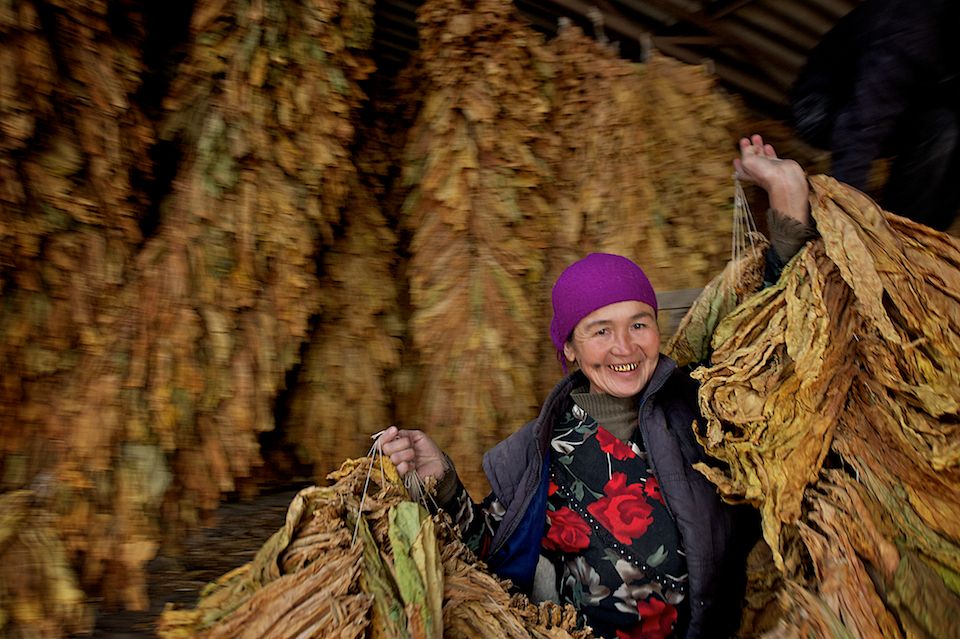
At the Chilik farm, tobacco leaves are dried naturally in the sun for 3–4 days. Drying ends when the leaves are completely dehydrated. They are removed in the morning, when the leaves are pliable due to the moist night air, making them soft and less likely to break.

The tobacco strings are tied into bundles (gavanki) and hung on rods in a barn or under a canopy. During drying, the tobacco is protected from wind and moisture. In this state, it is stored until it is fully ready for sorting.

From mid-September to the end of December, preparation for delivery begins. The leaves are sorted and pressed into bales. In an enclosed space, workers carefully remove the leaves from the bundles and pass them to the sorters. Both men and women participate in sorting — it is a process where work can be found for anyone.

Tobacco is sorted into six grades. The grade is determined by the color and quality of the leaves. One person can sort up to 60 kilograms of tobacco per day. During sorting, the leaves are aligned in the same direction and then pressed on a mechanical press into bales weighing 14 to 18 kilograms.


Finished bales are wrapped in coarse linen fabric for easier transportation. The tobacco company purchases all raw material down to the last leaf, providing guaranteed sales for farmers. After the entire batch is ready, it is sent to the “Philip Morris Kazakhstan” reception point.

According to the schedule, the farmer brings the prepared raw material to the receiving point. During the delivery season, the reception point handles 800–1000 bales per day. Previously, there were many more farmers, but due to the economic crisis their number decreased. According to statistics, in 2002 there were 4,700 farmers, but by 2011 only 200 remained.

From one hectare, a farmer harvests between 1.7 and 2.5 tons. The raw material is delivered together by both the farmer and the workers who grew and harvested the tobacco — this ensures transparency in subsequent settlements. As a reminder, each worker can earn between 1000 and 1500 dollars for six months of continuous work.

A rather amusing fact is that smoking is prohibited everywhere during the delivery of tobacco.

The tobacco company is interested in maintaining high product quality, so it provides maximum support to farmers. For example, it supplies them with necessary production materials, helps with seeds, and provides consultations on agricultural techniques, irrigation, seedlings, and the timing of the first leaf harvest.

There are six tobacco companies in Kazakhstan that share the market. The largest are JTI (44%), Philip Morris Kazakhstan (42%), and BAT (8–9%) (according to the “Kursiv” newspaper). However, only Philip Morris uses domestic raw material.

An expert uses a scanner to determine the grade of the tobacco, which affects its price: from 98 to 336 tenge per kilogram. Participation of both the farmer and the worker is important — so they can see firsthand at what price and at what quality each bale is accepted.

During the reception process, each bale is opened in six places to allow the company expert to determine the grade accurately. A barcode is affixed to each bale, containing full information about the grade, the producer, and the time and place of delivery.

When delivering tobacco, it is important to preserve the integrity of the leaves. The grade of tobacco is influenced by climatic conditions, proper care, and soil characteristics. It is considered that tobacco grows better in the south of Kazakhstan due to more suitable soil; the closer to Almaty, the heavier the soil becomes, which affects quality.

Samples of the “Talgarsky 28” tobacco variety are partially used in the production of local cigarette brands and are exported to Russia, Ukraine, the Czech Republic, and Lithuania. For foreign cigarette brands produced in Kazakhstan, a different tobacco variety is used, which is specially imported from Europe.

The laboratory technician takes samples to determine moisture levels. Moisture is measured within seven minutes using an evaporation method and must not exceed 18 percent. If the moisture level is above the acceptable limit, farmers take the tobacco back, dry it, and submit the bale with the next batch.

After that, the tobacco moves along a conveyor belt to temporary storage. Data for each bale is simultaneously entered into a central database. In the warehouse, the tobacco is sorted by grade. All detailed information is indicated on stickers. Around 400 tons of tobacco pass through the reception center each year.
The original version of the material was published on Voxpopuli.kz (before its closure in 2023). The author restored the text and photographs from a personal archive to preserve documentary and historical materials.

A detailed documentary report on how tobacco is grown in Kazakhstan — from planting to harvesting, drying, and grading.
Comments
No comments yet. Be the first to comment!