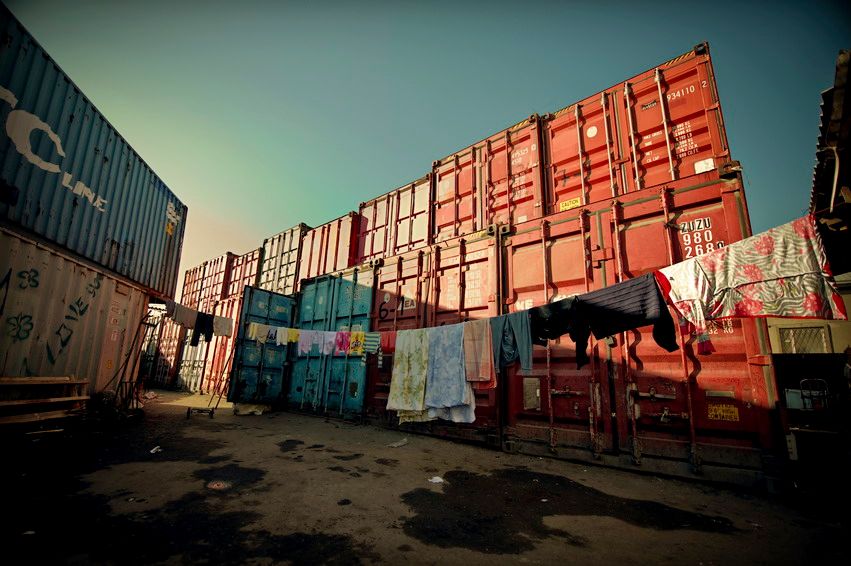
The Almaty neighborhood “Zarya Vostoka” resembles a vast city made of shipping containers. Almost every house has its gates wide open, porters move around carrying boxes and bundles, and people live in specially constructed barracks.

The owner of these containers is currently in Astana and comes here only once a month. His house stands directly opposite and is believed to be located in the most advantageous place — right at the entrance to the "Salem" flea market.

While the owner is in Astana, my brother and I with our families rent his house, says the local manager Alik. Our gates are always open, sellers who rent containers come in and out, bringing and taking their goods.

At this moment, one of the sellers came to pick up his merchandise.

Five meters from the house where Alik and his family live is the flea market, where its own lively rhythm never stops.

Gulchakhra came from Chunja to buy goods. Her brother and his wife live in an apartment here, and she is staying with them.

I have a law degree, but I couldn’t find a job in my specialty. I was even ready to carry documents from office to office, but even that kind of work didn’t exist for me, laughs Dilshat. So I came to the flea market: I started as a porter, carrying sacks, and little by little I began selling goods. I have been working here for five years. In winter I sell fur coats, and in summer — sunglasses.

Serik came from Shymkent; he sells prayer beads and Islamic books at the flea market.

Business at the flea market is built on everything.

I am Dungan, I came from Kordai, says Ramazan. I rent a room here with friends and earn extra money as a driver. I make as much as Allah gives, and I do not complain about my life.

Ramazan loads goods into the car — later he will deliver them to railway stations. From there, boxes of merchandise disperse all over Kazakhstan.

The cost of one “run” depends on the distance, volume and weight of the cargo.

Usually several people accompany one load: porters, carriers and drivers. The highest earners are the drivers — they can make up to 8,000 tenge a day. Porters on good days earn up to 6,000 tenge. Carriers take 300 tenge per delivery, but it is rare for them to make more than 10 trips a day.

Names of the seller or recipient are written on the boxes so the goods reach the right destination.

I have worked as a porter for 10 years, says Bolat (left in the photo). I moved to Almaty from Shymkent. I earn from 1,000 to 6,000 tenge a day. The job is not very good, but after all these years I got used to it.

We are not porters, we are carriers! — the boys protest.

All these porters, carriers, drivers, and shuttle traders live right next to the flea market. Enterprising people built barracks specifically for them, and visitors pay 15,000 tenge per month for a six-square-meter room.

But “Zarya Vostoka” is not only barracks and containers. There are also ordinary houses where native Almaty residents live. What unites everyone here is that nearly all residents work at or service the flea market.

There is no central sewage system in the neighborhood, so all wastewater flows through an open irrigation ditch.

Ilyas and Rasul are 11 and 8 years old. During the school holidays, they help their parents dig a pit for an outdoor toilet.

“Rasul has so many failing grades!” — laughs his older brother Ilyas.
“I only have one failing grade,” Rasul quickly corrects him.

Milana, Madi, and Ilyas are eight years old. During the holidays they collect empty shoe boxes from shuttle traders to use as firewood for the bathhouse.

Madi helps Milana carry her huge sack.

By five in the evening, the flea market closes and sellers take their goods to storage.

Tomorrow, around eight in the morning, these gates will open again.

In the evening, local elders come outside to play cards near a hot tandyr oven.

Hot flatbread made by local Uyghurs is among the most delicious in Almaty.

After work, the familiar driver Ramazan invites us to his home: “Well, you can hardly call it a home, but it’s warm, and we don’t need much more,” he says.

His older brother Suleiman works as a private taxi driver. The next day he is turning 42, but he will spend his birthday as usual — at the flea market.

Another resident, Yusuf, is preparing a salad for the table. “It is customary in our homeland to welcome guests warmly. My whole family lives in Kordai, and I work here transporting goods. We earn enough. I’m also saving for a kalym — my eldest son is getting married soon!”

Their neighbor Ilyas adds: “In Kordai I work in agriculture, growing potatoes and onions. But now it’s not the season, and staying home is boring, so I came here to look around.”

Cramped, but not resentful.

“Come visit us in Kordai!” Ramazan says as we part. “Life is different there: our house is big, the surroundings clean. You’ll try real Dungan plov and see a real Dungan wedding!”
The original version of this material was published on Voxpopuli.kz (before its closure in 2023). The author restored the text and photos from a personal archive to preserve documentary and historical materials.

Верблюжье ферма в Казахстане: труд, забота, традиции и редкие кадры рождения верблюжонка. Фоторепортаж для Shanger.kz

A documentary report on how tobacco in Kazakhstan is sorted, pressed, and delivered, revealing farmers’ labor and production stages.
Comments
No comments yet. Be the first to comment!